Weekly and four-week planning, time recording and the complete Visierung chain in one system. Eleven checks run before a plan is approved.
30 minutes, no risk, you see the real system
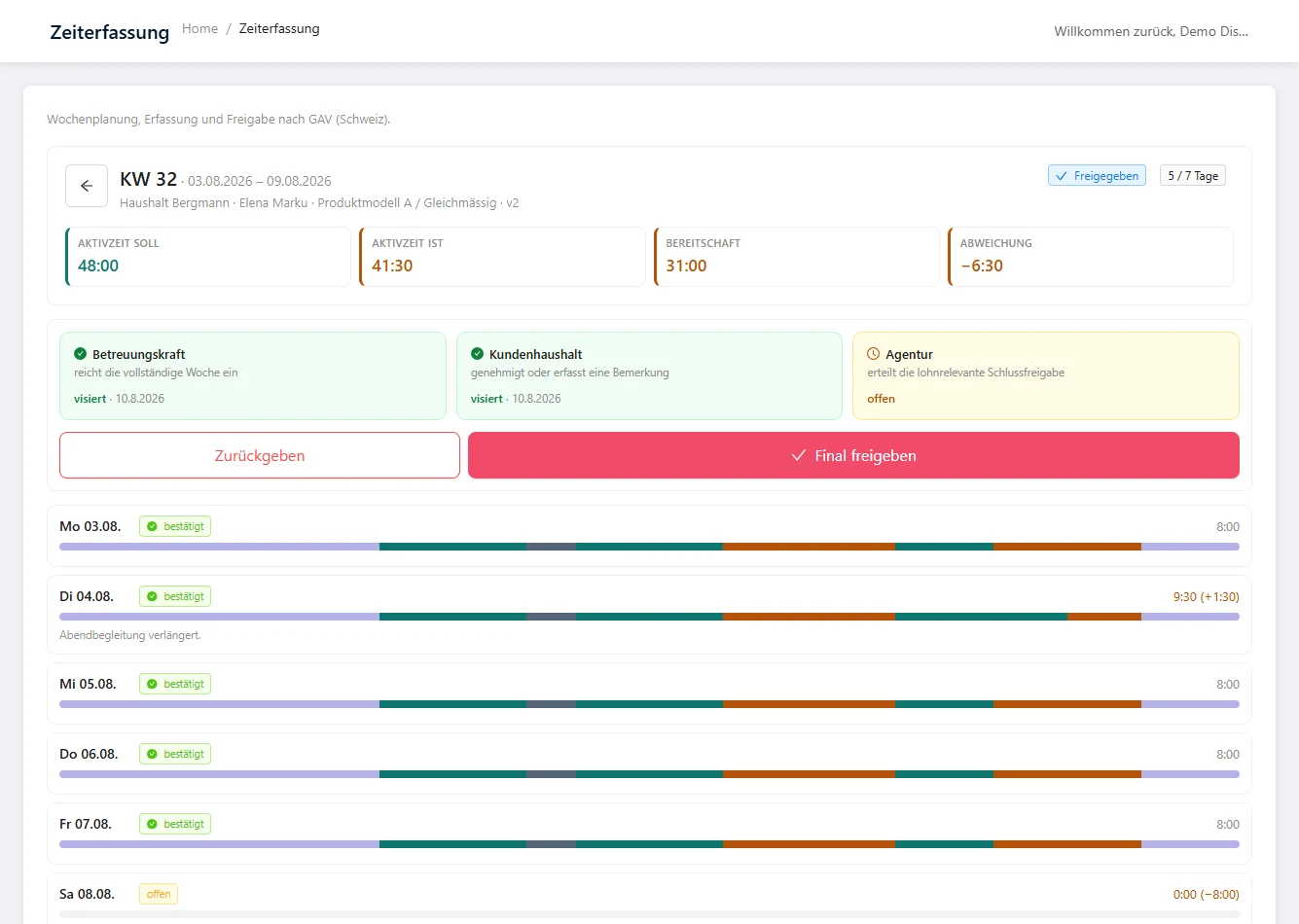
Under the new special provisions for live-in care (Art. 17a to 17e ArGV 2, the Swiss Ordinance 2 to the Employment Act), working hours and call-outs must be documented and signed off by everyone involved. Caregiver, client household and agency, every week, traceable and versioned. If you run this in spreadsheets and email chains, you have no reliable basis for the payroll run at the end of the month.
“Working hours and call-outs must be documented and signed off by everyone involved.”Special provisions for care in private households, Ordinance 2 to the Employment Act (ArGV 2, SR 822.112), Art. 17a–17e, in force since 01/12/2025 (translated from German)
Legal basis in full: Ordinance 2 to the Employment Act (ArGV 2), SR 822.112, Art. 17a to 17e — officially published in the Classified Compilation of Federal Legislation (Fedlex); the competent authority is the State Secretariat for Economic Affairs SECO. HerzensManagement covers the documentation and Visierung steps; it does not replace a legal assessment of your individual case.
GAV weekly planning (GAV: the Swiss collective labour agreement) is a separate module that is only activated for Swiss agencies. Austrian agencies see neither the menu item nor the data fields. Terms, rounding and rules stay cleanly separated instead of ending up in a shared form in which half of it does not fit any given market.
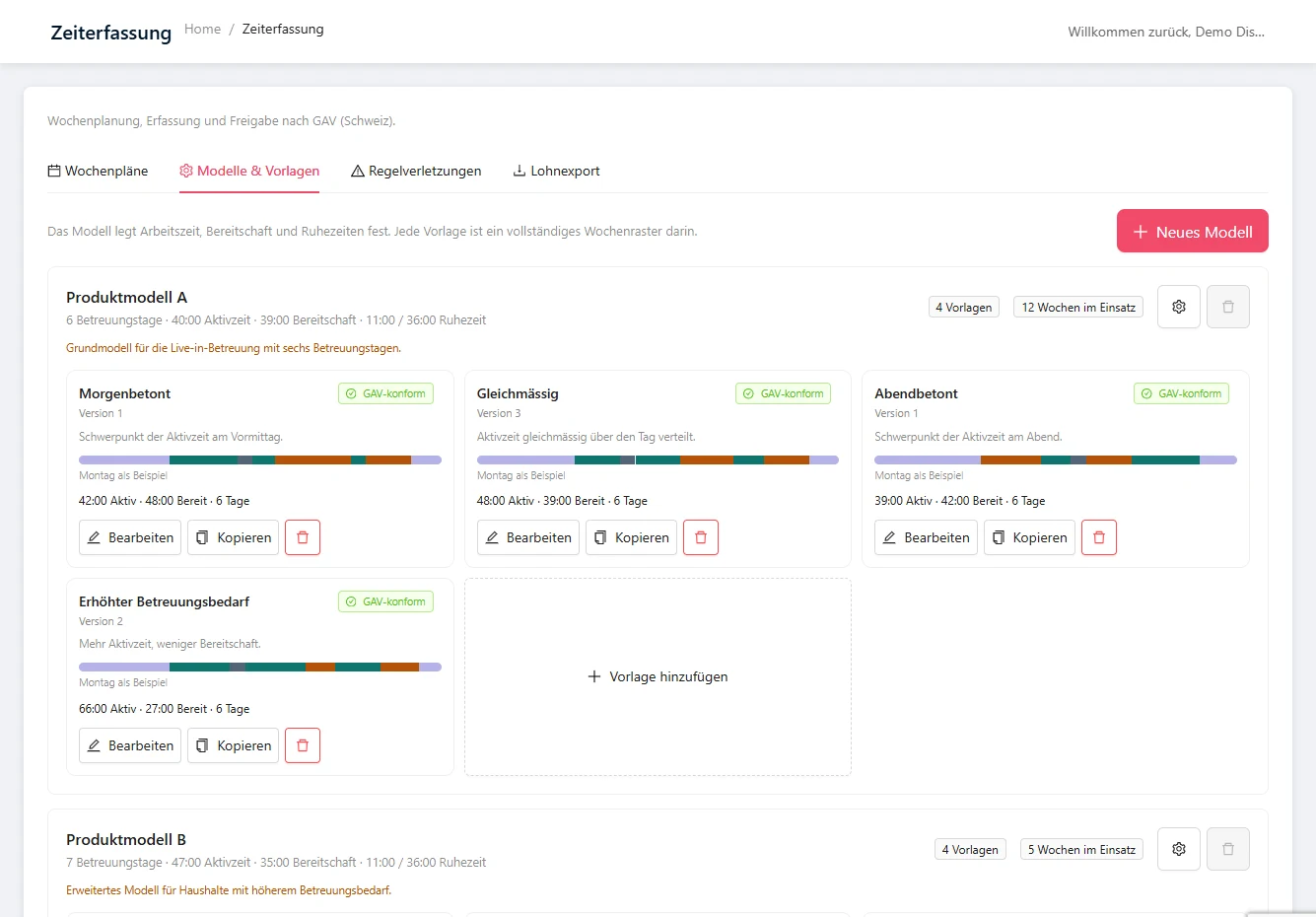
The product models are stored as master data in your agency, not in our code. You define how much active time and standby a week contains and which rest periods are guaranteed. You can create a new model or adjust hour values yourself, without waiting for a software release.
For each model you store at least four weekly templates, for example morning-weighted, evenly spread, evening-weighted and increased care needs. Each template is a complete seven-day grid of blocks for active time, standby, break, free time and rest period. Templates can be copied, adapted to a client and versioned.
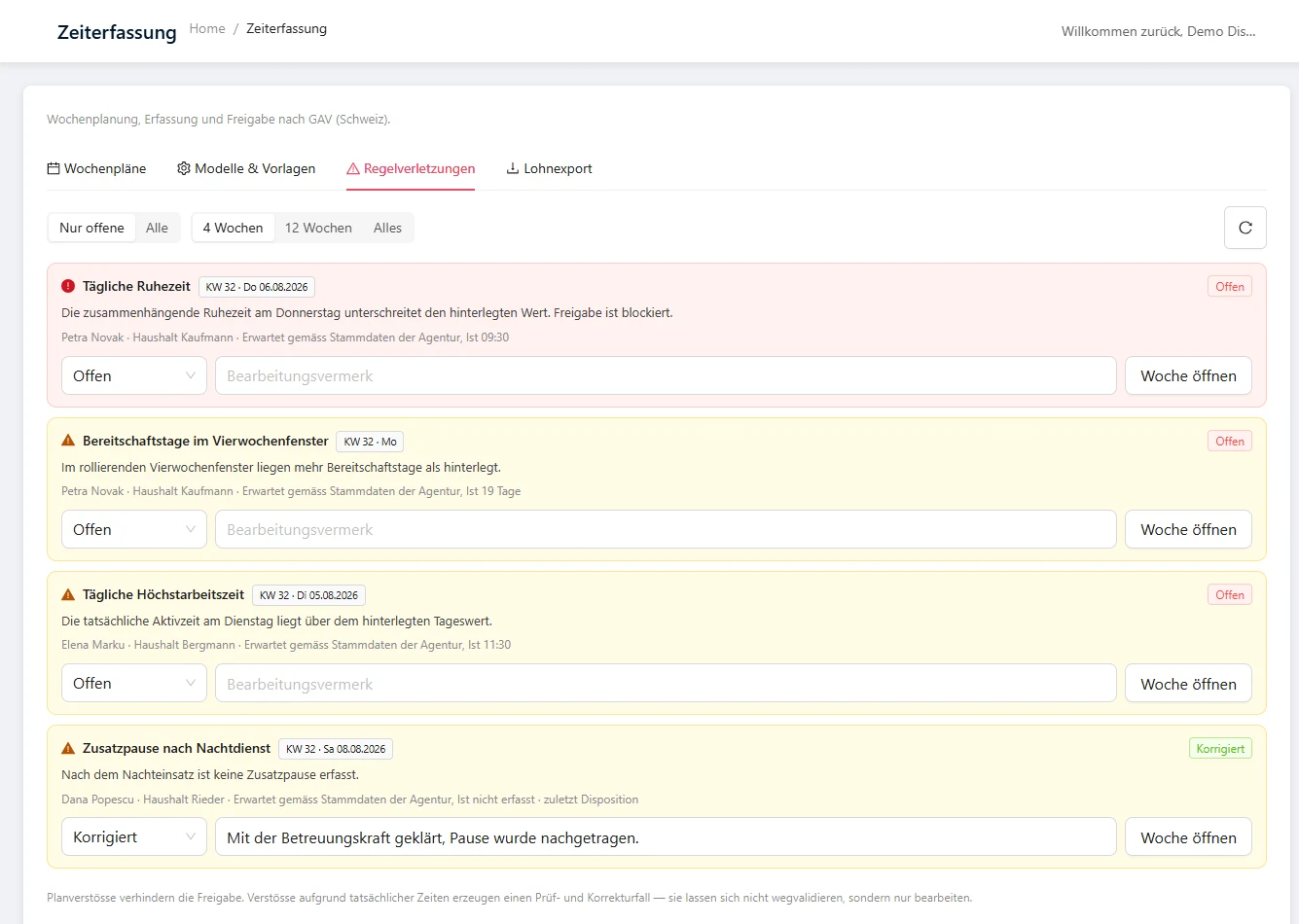
Every plan is checked against daily, weekly and four-week rules: maximum working time, standby days in the rolling four-week window, standby per day and how it is split, night-time call-outs, daily break, additional break after night duty, daily and weekly rest period, intervention time and availability in the household.
Violations in the plan block approval. Violations arising from the actual times block nothing, because you cannot validate away the past; instead they create a review and correction case in the back office.
| Rule | Level | Effect in the plan |
|---|---|---|
| 1. Maximum working time | Day · Week | Blocks approval |
| 2. Standby days in the rolling four-week window | 4 weeks | Blocks approval |
| 3. Standby per day | Day | Blocks approval |
| 4. Split of standby | Day | Blocks approval |
| 5. Night-time call-outs | Day | Blocks approval |
| 6. Daily break | Day | Blocks approval |
| 7. Additional break after night duty | Day | Blocks approval |
| 8. Daily rest period | Day | Blocks approval |
| 9. Weekly rest period | Week | Blocks approval |
| 10. Intervention time | Day | Blocks approval |
| 11. Availability in the household | Week | Blocks approval |
Diagram. Arising from the actual times, the same violation blocks nothing but creates a review and correction case in the back office. The stored limits are your agency's master data and are deliberately not shown on this page.
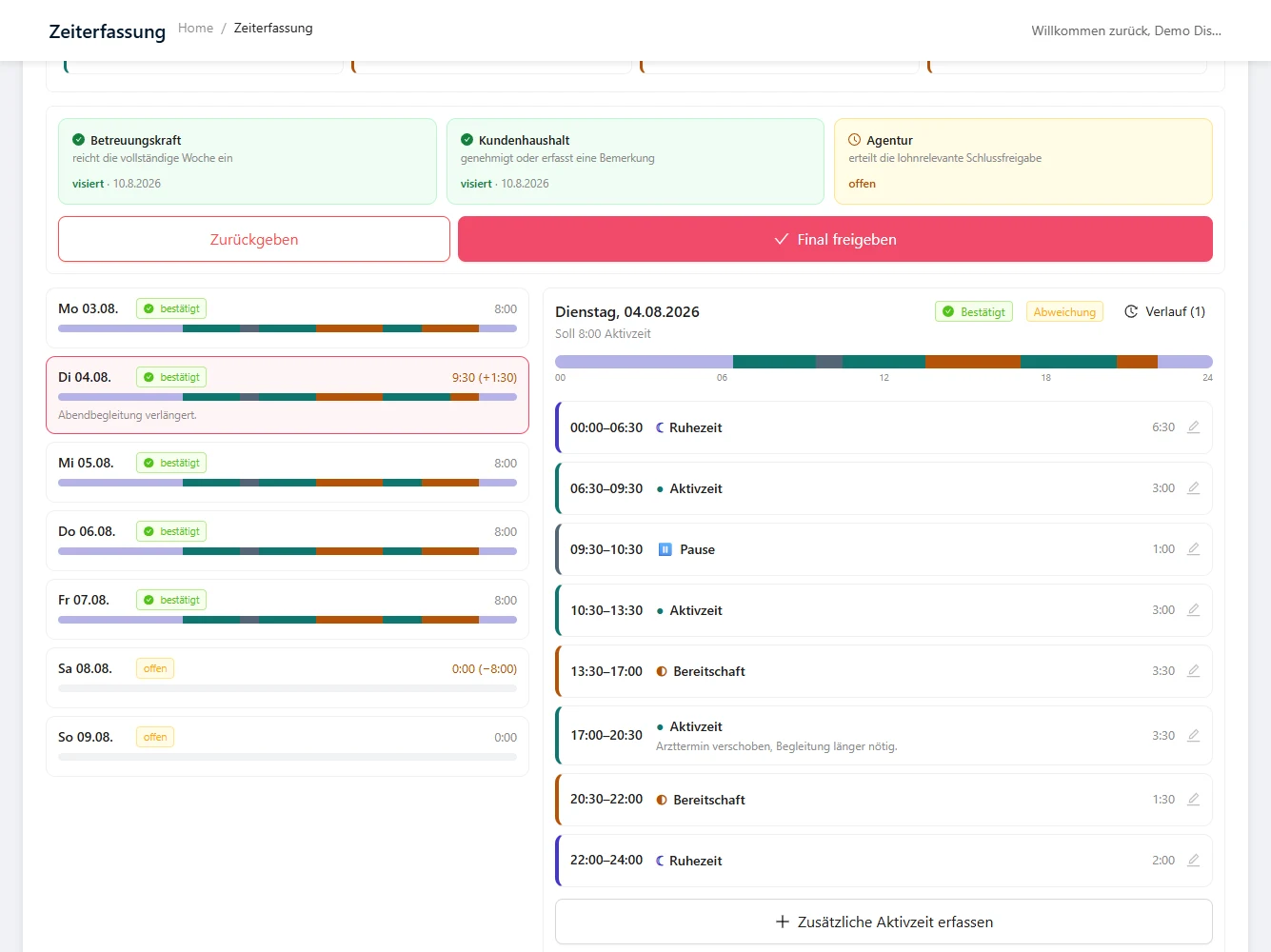
The approved plan is already in the caregiver's day view in the morning. If the day went as planned, they confirm all time blocks with one click, and the daily totals are fixed.
If something deviates, they tap the block concerned, change the start and end time and leave a comment. The planned value stays visible, struck through, and the deviation is calculated. Only deviations need attention.
The caregiver records actual call-outs during standby separately, with start, end, reason and travel time. If there are zero to two call-outs, the block remains standby and is counted at the stored rate. From the third call-out in the same block, the whole block switches to active time, the daily and weekly totals are recalculated and the check runs again automatically. This is exactly where spreadsheet solutions fail, because nobody recalculates retroactively.
The block remains standby and is counted at the stored rate.
The whole block switches to active time, daily and weekly totals are recalculated, and the check runs again automatically.
Diagram. Each call-out is recorded with start, end, reason and travel time.
The caregiver submits the complete week; after that, changes are only possible via a correction request. The client household approves, rejects or adds a comment. After final approval by your agency, the week is locked. Later corrections run exclusively as a new version with a reason, change history and renewed approval. Missing or overdue sign-offs automatically trigger a reminder to the responsible role.
Submits the complete week. After that, only a correction request.
Approves, rejects or adds a comment. Via a one-time link, without login.
Final approval. The week is locked and versioned.
It receives a one-time link by email, sees the weekly totals and the days that deviate, and clicks approve, reject or comment. No login, no additional licence seat.
If the week runs to standard and within the set tolerance, it goes straight to your back office. Whether a household signs off at all, you configure per client.
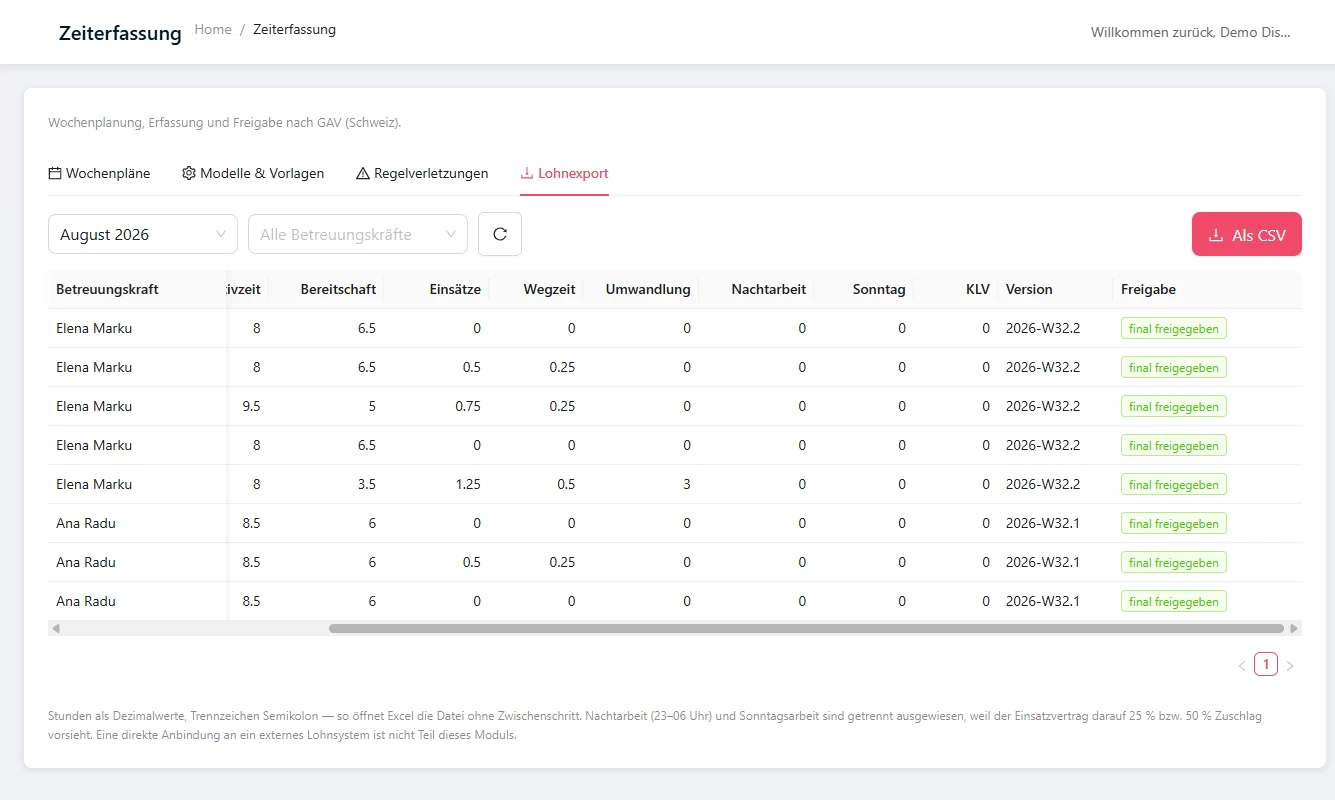
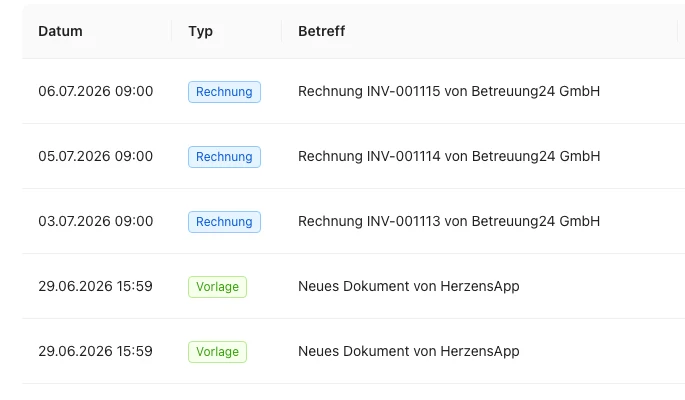
The export contains the daily totals for active time and standby, the actual call-outs during standby, the travel time and the standby blocks converted into active time.
Each row references the finally approved weekly version and its approval status, because without this reference the export is no use as a payroll record. Format: Excel and CSV.
GAV weekly planning is one module among several. Everything else runs in the same software.
The most common reason for putting off a switch is the legacy data: years of client households, caregivers, contracts and documents. That is exactly the part we take on - you just supply the export.
The data import function is a fixed part of HerzensManagement - not an extra service but built in: ready-made import routes exist for the care and placement solutions common in the German-speaking region. Tell us your current system - if there is no ready-made route, we develop the import specifically for you, free of charge and with no surcharge on your plan.
No export possible? Then sample files or access are enough for us - we build the route.
Effort for your team: one coordination meeting and the approval.
Structured, searchable and usable in day-to-day work from day one.
You keep control of your legacy data: we only import what you approve, and we record the migration in writing.
You do not need to know how to do any of this yourself. Tell us your current system; we will clarify the rest in the coordination meeting.
HerzensManagement comes with its own import function - including ready-made routes for common industry solutions. No add-on module, no setup fee, no migration flat fee, not even for larger volumes of data.
For systems without a suitable standard route - including in-house Swiss developments and Excel landscapes - we develop the import specifically for you, usually within 48 hours of receiving your data.
Your history is complete in the system from the start. You do not have to keep two solutions open for months or retype legacy data.
From €7 per client per month, full package €11. No setup fee, no minimum size.
Bring your trickiest cases. And if it turns out not to be a fit: 6-month money-back guarantee from go-live.