Two areas eat up most of the time in day-to-day agency work: the email inbox and assignment planning. HerzensManagement takes the routine off your hands in both. AI email sorts incoming messages and writes draft replies, and rotation planning works out follow-on rotations, conflicts and invoices by itself.
30 minutes, no risk, you see the real system
AI email and rotation planning are equally available to agencies in Germany, Austria and Switzerland. We put them front and centre here because they work independently of national rules: every agency has to answer emails and plan assignments, every day.
You connect your existing agency mailbox via IMAP and SMTP, including Gmail or Outlook. At the click of a button, HerzensManagement fetches the new emails and the AI classifies each one: category, status, urgency and a one-sentence summary. Instead of fifty subject lines, you read a list that already knows what needs a reply.
Asks for a call back about Friday’s changeover because the caregiver has to leave early.
Confirms the home visit on Tuesday at 10 a.m.
Asks for a copy of the invoice for August.
Sends the signed assignment contract as an attachment.
Monthly newsletter.
Diagram with made-up examples. Categories: Appointment, Invoice, Document, Client, Newsletter, Spam, Other. Status: Reply needed, Review, Waiting, Done. Emails can also be grouped by contact.
One click on “Suggest reply” and the AI writes a draft that knows the incoming email and the previous thread. If you like, you add an instruction, such as “Confirm the appointment on Thursday”. You store your agency's opening hours, contact persons and standard wording once in the knowledge base, and the drafts then sound like you.
Improve text, make it shorter, more professional or more detailed, correct spelling and adjust the tone: friendly, matter-of-fact, formal, empathetic or firm.
You search for clients, representatives, relatives and caregivers directly in the email window. Add them as recipients or give them to the AI as context, so the draft addresses the right person.
New emails are created from your templates. The names of client and caregiver fill themselves in, and required documents are attached from the profile. If something is missing, a notice warns you before sending.
It sorts and suggests. Emails are sent only by a person on your team, after a confirmation. If facts such as an appointment or a price are missing, the AI inserts a placeholder instead of making something up.
The AI receives a fixed selection of contact fields, no care assessment, no bank details, no rates. The mailbox password is stored encrypted, and each agency's data stays separate.
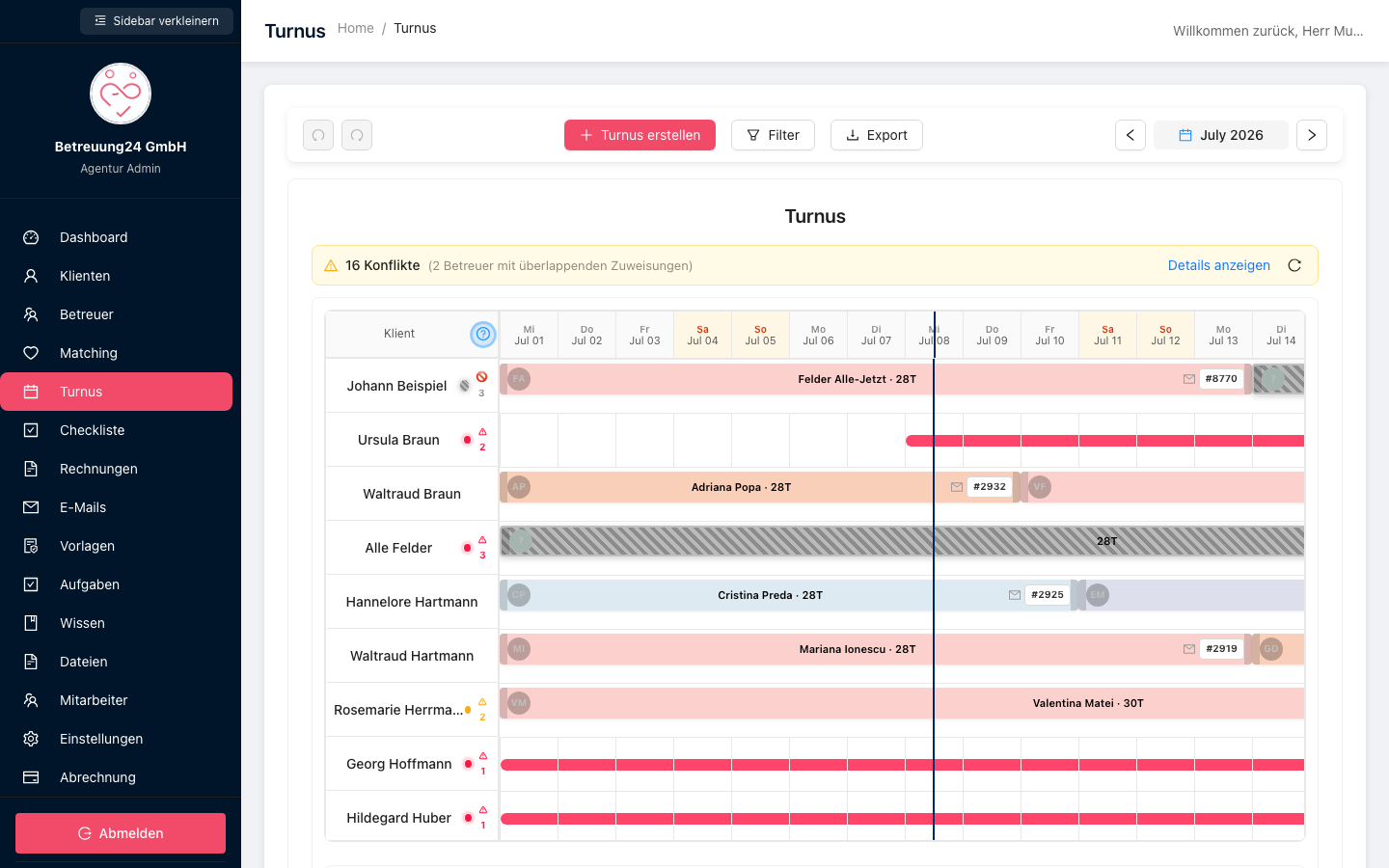
A single rotation, a recurring series or two caregivers who take turns: the plan appears in the timeline from the start date and rotation length, including changeover days. Open-ended series extend themselves every night. If an arrival moves, you drag the bar or shift all following rotations by a few days, without anyone recalculating.
If a caregiver is double-booked or a client is covered twice, the system reports the conflict immediately, even while you drag in the timeline. A shared changeover day is allowed, just as in real life.
Gap detection shows clients without care, sorted by the next gap. The dashboard shows the upcoming changeovers for the next 7 days and the unfilled rotations for the next 14 days.
A rotation is extended and the case number stays the same. Follow-on rotations shift together. And if a step goes wrong: Ctrl+Z undoes it.
Every rotation already carries its billing with it. After the check, the invoices are created from the rotation, individually or in bulk. If you wish, they go out automatically a set number of days before the rotation ends. If the rotation changes beforehand, the draft is recalculated, as long as nobody has edited it by hand.
Single, recurring or alternating. The system shows conflicts and gaps.
Your team ticks off the rotation. Open points become tasks.
As a draft or directly as a PDF, automatically before the rotation ends if you wish.
AI email and rotation are two parts of many. Everything else runs in the same software.
For Austria, HerzensManagement maps additional fields such as Pflegestufe (the Austrian care level), Pflegegeld (the Austrian long-term care allowance) and SVNR (the Austrian social insurance number), and for Switzerland the GAV (Swiss collective labour agreement) weekly planning. German-specific fields such as the Pflegegrad (the German care grade) are not implemented as a dedicated feature. Master data, templates and reports can be adapted to your processes. Anything else your agency needs, we clarify in the demo appointment, before the contract and not after.
From €7 per active client per month, full package €11. No setup fee, no minimum size, the same prices across the entire DACH region.
Bring your full inbox and your trickiest rotation. And if it does not fit after all: 6-month money-back guarantee from go-live.
Made in Austria. In use in Austria, Germany and Switzerland.